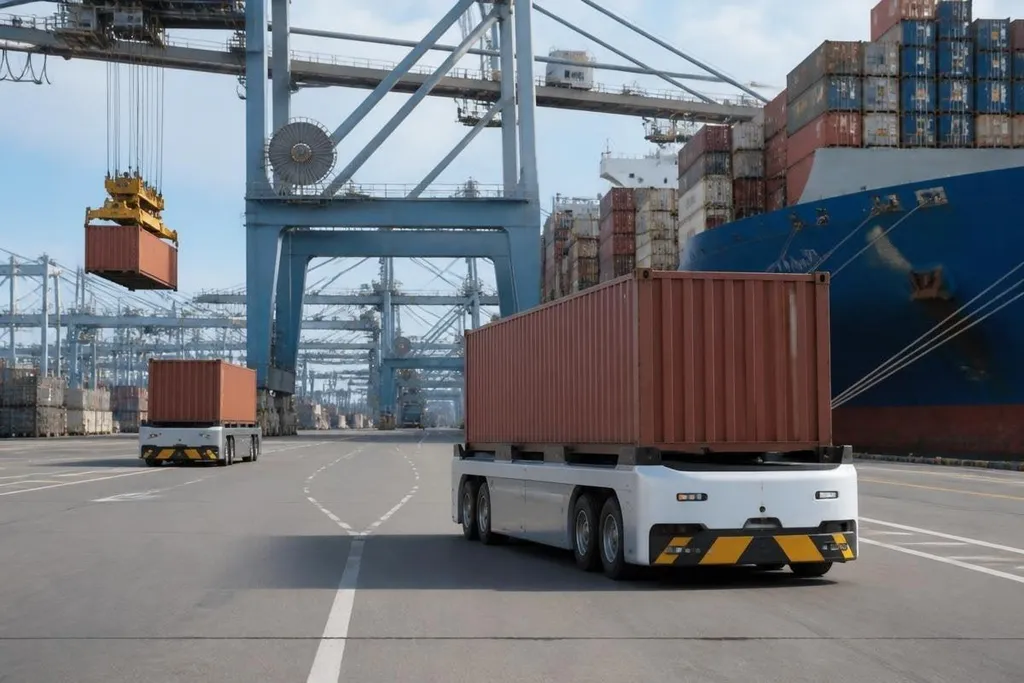
A port has to move containers between ships, trucks, rail lines, and storage yards without losing track of each box. Robots are becoming more useful in that work because they can repeat set routes, carry loads, and operate in areas where people face traffic and weather risks.
This article looks at where port robots help, how they work, and what still limits them.
Quick read
- Yard robots move containers between fixed points.
- Cameras, LiDAR, and software help robots find their position.
- Human staff still handle exceptions, repairs, and safety decisions.
The work ports need to repeat
Container handling has many repeated movements. A vehicle may collect a container from a crane, carry it across the yard, and place it in a marked slot before returning for another load.
That pattern suits autonomous mobile robots, often called AMRs. In a port, the robot may use cameras, LiDAR, satellite positioning, or fixed markers to work out where it is. LiDAR measures distance with light pulses, giving the robot a map of nearby objects.
The value comes from repeatability. A robot can follow a set route through a yard while software assigns its next job. People still set the rules, monitor traffic, and step in when a container, truck, or damaged road surface changes the plan.
Why ports are turning to robots
Port yards contain heavy equipment and moving vehicles. A robot can take on a route that would otherwise keep a driver inside a vehicle for many repeated trips, while a remote operator can watch several machines from a control room.
That change also affects staffing. Port staff still need knowledge of cranes, cargo systems, maintenance, and safety.
The job may shift toward supervising equipment, checking faults, and handling work that software cannot classify.
Battery power adds another reason to automate. A robot can return to a charging point when its battery reaches a set level, then receive another job after charging. The terminal must still plan charging space, cable access, battery checks, and backup vehicles for busy periods.
For an operations manager comparing port robots, port automation reporting from Robot24.com can connect deployment claims to the terminal, machine limits, and company choices behind them.
Where the hard problems remain
Outdoor ports are difficult places for robots. Rain can affect cameras, salt air can damage parts, and strong sunlight can make vision systems work harder. Containers may block signals, while trucks and people can appear in a route without warning.
A robot also needs accurate information about the yard. If a container sits in the wrong slot, a lane closes, or a crane changes position, the software has to receive that update quickly. A route that works on a map may fail when the physical yard no longer matches the map.
Safety adds another layer. Port operators need clear stop rules, warning systems, low-speed zones, and a way to take control. The system must record what happened after a stop so staff can fix the cause instead of restarting the robot and hoping for a better result.
The business case has limits, too. A robot may reduce driving work, but the port still pays for sensors, software, charging equipment, repairs, network coverage, and staff training. A small terminal with changing cargo patterns may gain less than a large yard with steady routes.
A practical buying check
Before a port orders robots, its operations team should check:
- Route stability: Can the machine repeat the same trips often enough to justify setup work?
- Cargo fit: Does it handle the container sizes, weights, and lifting method used on site?
- Traffic rules: Can the robot stop safely around trucks, cranes, workers, and emergency vehicles?
- Network coverage: Will control data reach the machine across the full yard?
- Recovery plan: Can trained staff move the robot or cargo after a fault, power cut, or blocked lane?
These questions move the discussion beyond robot count and toward work completed. A port should measure waiting time, completed container moves, unplanned stops, and repair time before it expands a trial.
I'd buy port robots for stable yard routes first, then expand only after the stop rate and repair workload hold up across a full operating period.
The next useful proof will come from ports publishing those operating numbers. Until then, the machines are most convincing where the route is fixed, the cargo is known, and a person can take control when the yard changes.